
As the School of Integrative Biology (SIB) continues to strengthen support systems for students in foundational Science, Technology, Engineering, and Mathematics (STEM) courses, the Merit Program remains a cornerstone of that mission. This fall, the program welcomed its new Assistant Director, Erinn Dady, whose own journey through academia informs her passion for student success. In a recent conversation, Dady shared what drew her to the role, how she sees the Merit Program shaping community and confidence among biology students, and where she hopes to guide its growth in the years ahead.
When Dady stepped into her new role as the Assistant Director of the Merit Program for Integrative Biology, the position already felt like a natural extension of the educational values she developed as a graduate student. Her earlier experience as a teaching assistant for the IB 150 Merit sections left a strong impression. “I saw how valuable these extra class sessions were,” she says. “The standard discussion is 50 minutes, but the Merit discussion is two hours—and that makes such a huge difference.” She recalls watching students come out of their shells, form friendships, and engage with course material in a deeper, more confident way.
That student-centered environment drew her back when the position opened just as she completed her thesis. “When I went back to school myself, I wanted to do something to make science or education better,” she explains. “This job opening up felt like a dream.”
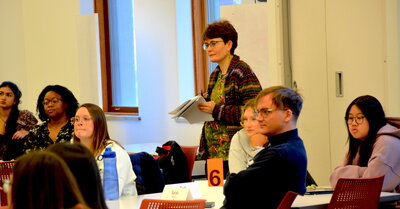
The IB Merit Program is part of the Merit Program for Emerging Scholars, a broader effort across STEM departments that includes mathematics, chemistry, molecular & cellular biology (MCB), and SIB to support high-achieving students through active, collaborative learning. Many Merit students arrive academically strong but may feel socially isolated; several are first-generation undergraduates or come from smaller high schools. To address this, Merit offers extended workshop-style problem-solving sessions led by trained facilitator-instructors, where students work closely in small groups, receive feedback, and build community. Most students who take Merit sections get higher grades in the course than they would have otherwise, and report feeling more connected to other people in class. “The biggest benefit is the confidence that comes from learning to support your answer with reasoning,” Dady notes, highlighting how the program helps students develop not only mastery of concepts, but also the ability to articulate and defend their thinking.
As she settles into her role, Dady is focused on expanding opportunities for students and improving spring enrollment, which has historically lagged behind its fall semester counterpart. She is working to build stronger recruitment pipelines in collaboration with MCB and hopes to increase participation in upper-level Merit-supported courses. She is also particularly passionate about connecting students with research opportunities. Her own undergraduate research experience opened doors she hadn’t anticipated, and she hopes to strengthen similar pathways for Merit students. “Even if you decide you don’t like research, that’s just as valuable,” she says. “You don’t want to enter a graduate program and realize after starting that it’s not for you.”
Looking ahead, Dady envisions a Merit Program with broader offerings, more interdisciplinary collaboration, and more experiential learning—experiences that help students see the relevance of what they're learning in the classroom. “If resources were unlimited, I’d love to have an offering for every class,” she says.
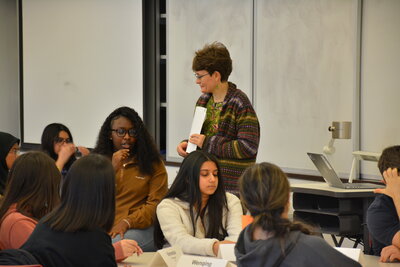
One of her favorite things about the Merit Program is that it is open to anyone. During her undergraduate classes, she found out about the program and asked to join the Ecology Merit section. That class provided her with a deeper connection to the material learned in lecture. Her approach to the role is shaped by empathy and lived experience. As a nontraditional student who once struggled to find resources and confidence, she understands the challenges students face. “I try to be aware that students may face challenges I can’t see,” she says. She hopes students feel supported as they navigate both academic and personal obstacles.
For Dady, the rewards of the work are clear: “Seeing people’s confidence grow—whether it’s at the whiteboard or when they present their summer research—that’s the best part.” She hopes that impact resonates not only with current students but also with alumni who once benefited from Merit’s collaborative approach. Because alumni perspectives offer crucial insight into how the program shaped their academic paths, Dady welcomes hearing from former participants and learning what aspects supported them most. Whether by sharing feedback, offering mentorship, or simply staying engaged with the School of Integrative Biology, alumni can play an important role in sustaining the community that Merit works so hard to build.
If you wish to speak with Erinn about the Merit Program, please contact her at erinnrd2@illinois.edu.