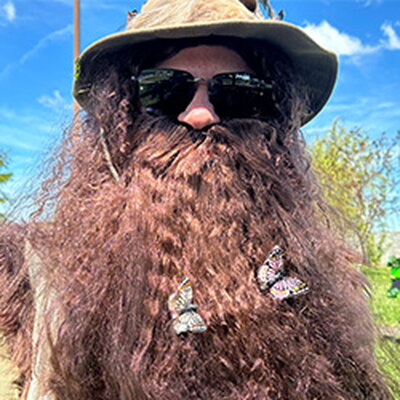
When Phil Anderson first heard about Cosplay for Science, it wasn’t in a comic book store or at a convention, it was at a scientific conference. During the Society for Integrative and Comparative Biology meeting in early 2024, Anderson sat in on a presentation from Middlebury College entomologist Greg Pask, who described a class project where students dressed as Pokémon trainers to teach children about insect biology.
“I thought, this is super cool,” Anderson recalls. “I’d never heard of anything like it. I went up afterward and started chatting with Gabriel-Philip Santos, one of the founders of Cosplay for Science and it just snowballed from there.”
As both a biologist and a table-top role-playing game enthusiast, Anderson saw a creative path forward. The imaginative worlds of Dungeons and Dragons, with their carefully detailed creatures and ecosystems, became a starting point to explore how storytelling and science could work together. Soon, he was leading a team of Illinois students to build something new — a Midwestern chapter of Cosplay for Science that uses popular culture to inspire scientific curiosity.
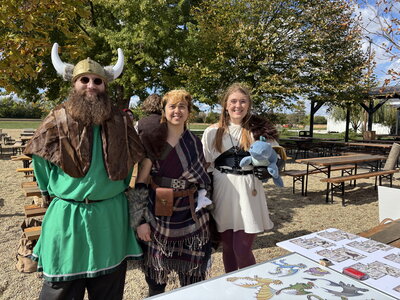
That curiosity turned into action in fall 2024, when Anderson and his students hosted their first outreach event at Riggs Beer Company in Urbana. Themed around invasion biology and DnD, participants battled “honeysuckle monsters” and learned about real-world ecology through a mix of costumes, dice rolls, and scientific storytelling. The experience was featured in Cosplaying Science, highlighting how fantasy can illuminate environmental realities. The event was such a success that in the spring of 2025, Anderson and his team brought the event to the Anita Purves Nature Center in Urbana.
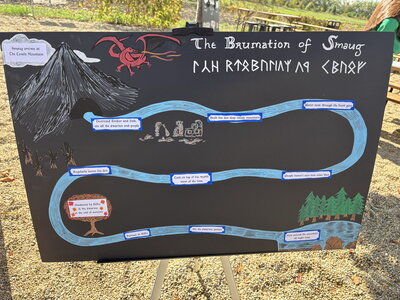
Encouraged by the response of the first two events, Anderson and his volunteers expanded their scope the following year with The Multi-Planar Dragon Expo at Riggs Beer Company. Each student designed an activity inspired by their own research, from exploring dragon flight mechanics to studying thermoregulation through Smaug’s hibernation in The Hobbit. To promote the event, two of the students involved shared their experiences in Bringing Dragons to Life: How Science and Fantasy Unite at the Multi-Planar Dragon Expo, emphasizing how the project transformed their understanding of outreach.
“This wouldn’t exist without the volunteers,” Anderson says. “This isn’t part of a class or requirement for their degree. They do it because they love it and because it lets them share science in creative ways.”
The student-led energy behind Cosplay for Science has built a bridge between campus and the local community. Several participants come from the university’s The Illini Metagamers, a group of over 200 tabletop and board-game enthusiasts who now help design activities, recruit volunteers, and bring fresh perspectives to each event. That enthusiasm has also drawn interest from other institutions. Currently, Anderson is in conversations with faculty at other Midwest Universities about launching a similar program.
The story of Illinois’s growing Cosplay for Science community, from its first DnD-inspired outreach to its latest multi-universe dragon event, is captured in Cosplay for Science Brings Education and Imagination Together in Urbana-Champaign.
Looking ahead, Anderson is turning that local momentum into broader impact. He and his students are exploring bringing Cosplay for Science to both C2E2 in Chicago and the University of Illinois UI-Con. If approved for C2E2, the team will partner with Illinois-Indiana Sea Grant to create a Subnautica-themed booth connecting aquatic ecology and invasive species through game-inspired storytelling. Locally, they’re planning a panel on the anime series Delicious in Dungeon that will reimagine anime characters as field researchers documenting the ecology of fantastical creatures — blending humor, science, and imagination into one immersive experience.
Anderson’s curiosity continues to drive innovation beyond conventions. He’s slated to lead workshops on science communication at future conferences, including the Ohio Valley Invasive Species Symposium in 2027, and he’s developing biology-inspired DnD modules to help educators bring storytelling into the classroom.
Through it all, his goal remains simple: make science more approachable through wonder. “We’re not trying to be the scientists who say, ‘That wouldn’t work,’” he says. “We’re asking how it could work. That’s how you get people to engage — through curiosity and imagination.”
If you'd like to get involved or bring Cosplay to Science where you are, please reach out to Phil Anderson at andersps@illinois.edu.