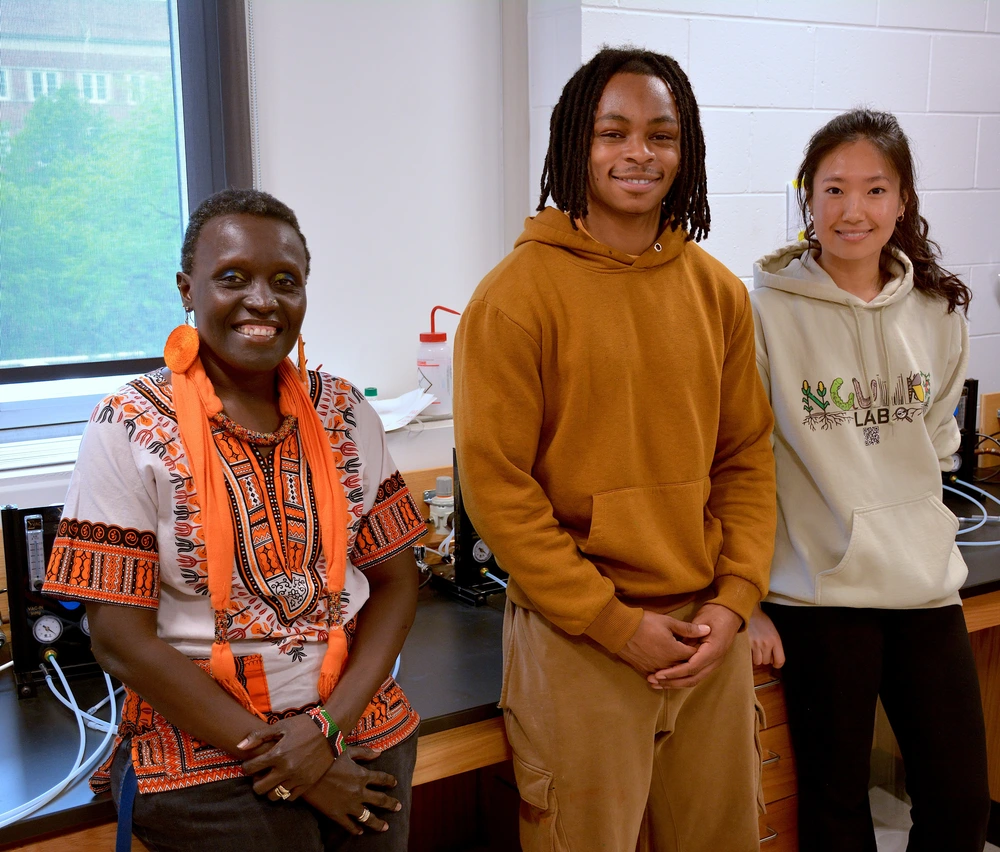
A newly published study in the Journal of Chemical Ecology offers new insight into how plants respond when faced with multiple environmental challenges at once. This work was led by former undergraduate researchers in the lab of Assistant Professor in Entomology Esther Ngumbi.
The research explores a deceptively complex question: how do plants respond when stress doesn’t come one factor at a time, but rather all at once? The paper was authored by lead researcher and now graduate student in Ngumbi’s lab Michael Somerville, alongside former undergraduate researchers Emma Cartelli and Minxing Zhu, the latter of the two is pursuing graduate studies in the School of Integrative Biology (SIB).
The aforementioned question is rooted in curiosity and challenges long-standing assumptions in plant science. In agricultural environments, crops rarely face a single stressor. Flooding, insect feeding, and other challenges often occur simultaneously, yet most research has historically examined them in isolation. This study set out to rethink that approach, asking what might be missed when complexity is simplified.
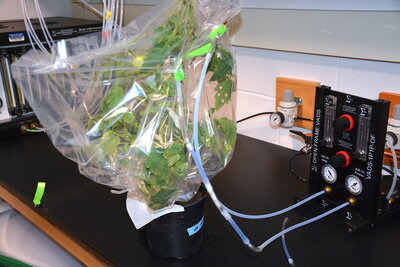
Working with two types of tomato plants—an heirloom variety and a modern hybrid—the research team examined how plants responded to flooding and insect feeding, both independently and in combination. Using advanced chemical analysis techniques, they tracked changes in plant metabolism and the release of volatile organic compounds, which play a critical role in plant defense, communication, and interactions with insects and microbes.
What the team found underscores just how dynamic plant responses can be. Flooding emerged as the dominant force shaping plant chemistry, while insect feeding triggered its own distinct pathways. When combined, however, these stressors revealed that flooding often overrode or reshaped the plant’s defensive responses.
The findings point to a more nuanced understanding of plant resilience, particularly as global change increases the likelihood of overlapping environmental stressors. They also highlight the value of collaborative research approaches. This is something that was exemplified by the contributions of undergraduate researchers like Zhu, Cartelli, and Somerville.
“This was my first research experience, and I felt fortunate in participating in it because I learned so much, my love for research derives from it,” says Zhu. “At first I was confused, I didn’t really know what I was doing. I simply followed the protocol and the instructions of the graduate students. But through literature review, talking with graduate students and Dr. Ngumbi, I gradually understood the basics of the system: what are we doing, what is the point of doing this, and how we are going to do it. After that, it just became knowledge gap filling.”
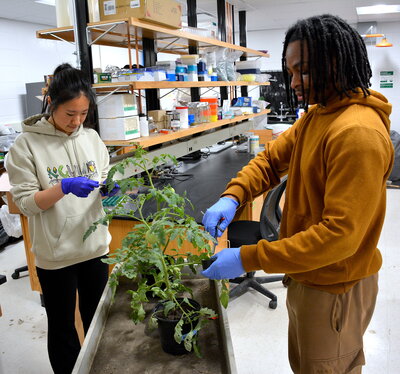
For Somerville, his spirit of inquiry shaped his research in Ngumbi’s lab. He was originally drawn to Ngumbi’s research because it was unfamiliar, joining her team with little background in plant science but a willingness to explore something new. What he found was not only a field that sparked his curiosity, but a space where he felt a sense of belonging.
When Somerville first joined the Ngumbi lab in 2022 as a summer undergraduate researcher, he had envisioned a very different future. He had joined SIB to pursue a career in genetics, but not necessarily in plant science. However, as his research evolved, so did his vision. His interests in genetics remain, but his experience in the lab opened new possibilities, shifting his goals toward becoming a genetic engineer and plant breeder.
Like Somerville, Zhu’s continued path into graduate study reflects the lasting impact of undergraduate research experiences in SIB. What began as an introduction to research grew into a sustained academic and professional trajectory, shaped by hands-on discovery and mentorship.
However, Somerville’s path wasn’t without challenges. As the lead author on the paper, Somerville navigated the complexities of the publication process while balancing coursework, revising drafts, and refining his scientific writing. At the same time, he developed leadership skills, learning how to delegate tasks and collaborate effectively with peers—including fellow undergraduate researchers like Zhu and Cartelli.
Still, the process kept him motivated. Whether working on the manuscript while studying abroad in Costa Rica, during late nights in his dorm, or on train rides to Chicago, he remained committed to seeing the research through. “There were many days where I dropped everything and worked on the manuscript,” he said.
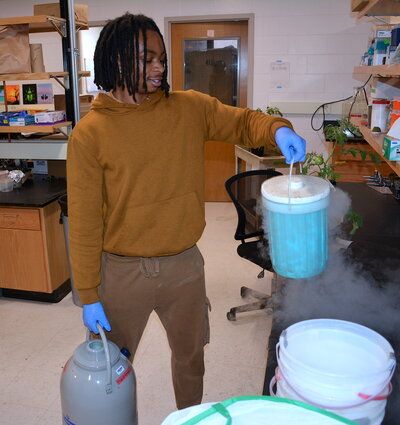
When the paper was finally accepted, the moment was emotional. It brought a sense of validation and relief. The publication provided a confirmation that the long process of questioning, testing, and refining had led somewhere meaningful.
The project highlights the power of sustained undergraduate research within SIB. What began as a summer experience evolved into a long-term commitment, with students contributing across fieldwork, lab work, and publication.
Now published, the study stands as both a scientific contribution and a reflection of what can happen when students are encouraged to ask bold questions and given the space to pursue them.
For undergraduates considering research, Somerville offers this advice: “Getting involved in research is a lot like dating,” he said. “You try different things, learn what you don’t like, and eventually find what makes you feel comfortable, valued, and passionate.” Every experience, he emphasized, is part of the process of discovery.