
When Dr. Ya Min (Minya) joined the Plant Biology faculty, she already knew which course she hoped to teach.
"I love plants and teaching people the wonders of plants," she said. "So IB 103: Introduction to Plant Biology was the ideal teaching assignment. When I interviewed, I made it clear that it was the course I was most excited about and that I wanted to teach."
That passion has shaped a reimagining of the class, transforming the long-running introductory course into an experience that blends scientific discovery with creativity, modern technology, and hands-on learning. Now, that vision is receiving another boost through the College of Liberal Arts & Sciences' Curiosity to Impact Fund, which recently awarded funding to further assist Minya in achieving her goal in updating the course.
Her winning proposal, titled "Reimagining Plant Biology in a Changing World," will allow Minya to purchase twenty-four new stereo and compound microscopes equipped with Wi-Fi and touchscreen displays. This upgrade in technology will replace aging equipment that has become increasingly difficult to use. With the new microscopes, students will have access to clearer images, improved accessibility for those that need it, and a new opportunity to capture and export high-quality photos of their specimens.
“In the lab component of the course we use microscopes a lot,” says Minya. “The stereo microscopes are for dissecting and looking at slightly bigger structures while the compound microscopes let us view slides. So we use them a lot, basically in every single lab.”
By being able to see the intricate structures of plants firsthand, students can understand some of the more abstract concepts, turning them into tangible discoveries. With the touchscreens, students will be able to save and share images from their own work, allowing them to showcase their accomplishments. This upgrade in technology allows for a greater sense of ownership over the learning process while matching other digital tools that students use in their everyday life.
With the upgrades to the microscopes forthcoming, Minya is able to continue her endeavor in blending new educational techniques with the essential information students need. While the core concepts of the introductory plant biology course have remained unchanged—how plants evolve, function, and adapt—the way students experience those concepts has been redesigned from the ground up.
Instead of asking students to memorize core concepts about plant biology, Minya strives to connect classroom lessons to current research happening in the School of Integrative Biology, at the University of Illinois, and beyond. Not only do students learn how plants work, but also how plant science influences fields ranging from ecology to engineering and bio-inspired design. Throughout the semester, she encourages students to see how the ideas they’ve learned in class extend far beyond traditional plant biology.
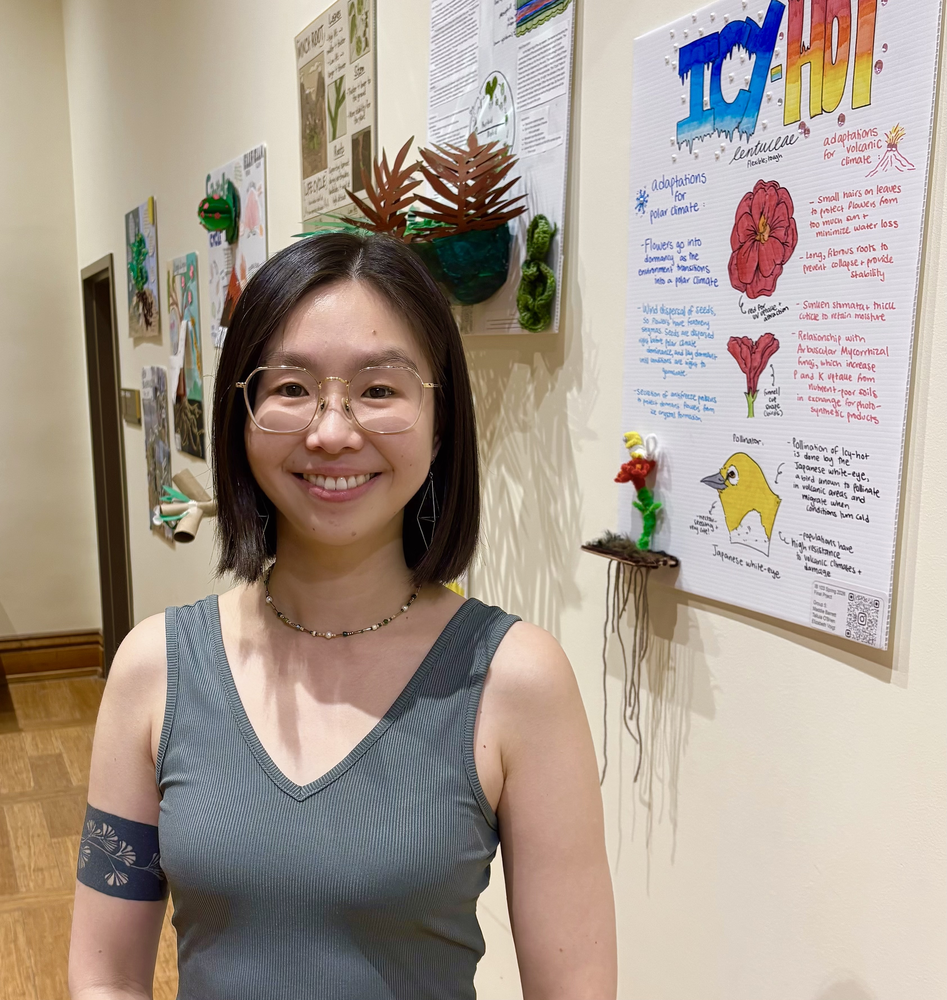
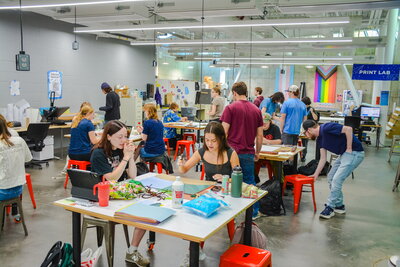
That same philosophy carries into the course's new final project. Instead of producing a traditional scientific poster, student teams are challenged to communicate what they’ve learned through creative design. Working in small groups, students first develop their own plant and how it could evolve to survive in two drastically different environments that alternate throughout a year. Once the plant is created, they then bring those ideas to life through artwork, physical displays, and two-minute videos. The projects are developed in collaboration with The Shop at the Siebel Center for Design, where students have access to numerous creative resources such as 3D printers and fabrication tools that many may not have known were at their disposal.
The videos, which are presented during the final week of class and shared on the course's Instagram account (@uiucib103), encourage students to explain scientific concepts in ways that are engaging for friends, family, and the public. Some projects are humorous, others artistic, but each asks students to demonstrate their understanding by teaching others.
"The best way of learning is when you explain something back to someone," says Minya. "I find it is even more effective when it’s being done in creative ways."
The results so far have exceeded her expectations. After both days the videos were shown, students continued discussing each other's projects once class was done. And what did they do while the videos were shown during final lectures? Students were encouraged to rate their classmates work in a google form. The highest-scoring creations are now displayed publicly on the second floor of the Natural History Building, extending learning beyond the classroom and into the community.
And although IB 103 has been transformed, Minya sees her work with the course ongoing. As an active researcher, she regularly incorporates new discoveries, ensuring students encounter plant biology as a living, evolving field rather than a finished body of knowledge. By doing this, it leads back to Minya’s drive to show students how plant biology extends past the classroom.
That commitment to innovation is exactly what the College of Liberal Arts & Sciences hoped to encourage through the Curiosity to Impact Fund. The redesigned IB 103: Introduction to Plant Biology demonstrates how curiosity can inspire new approaches to teaching, empower students to communicate science creatively, and improve the tools they use to explore the natural world. By combining research, technology, art, and discovery, the course is preparing students not only to understand plants, but to think creatively about the impact science can have far beyond the classroom.