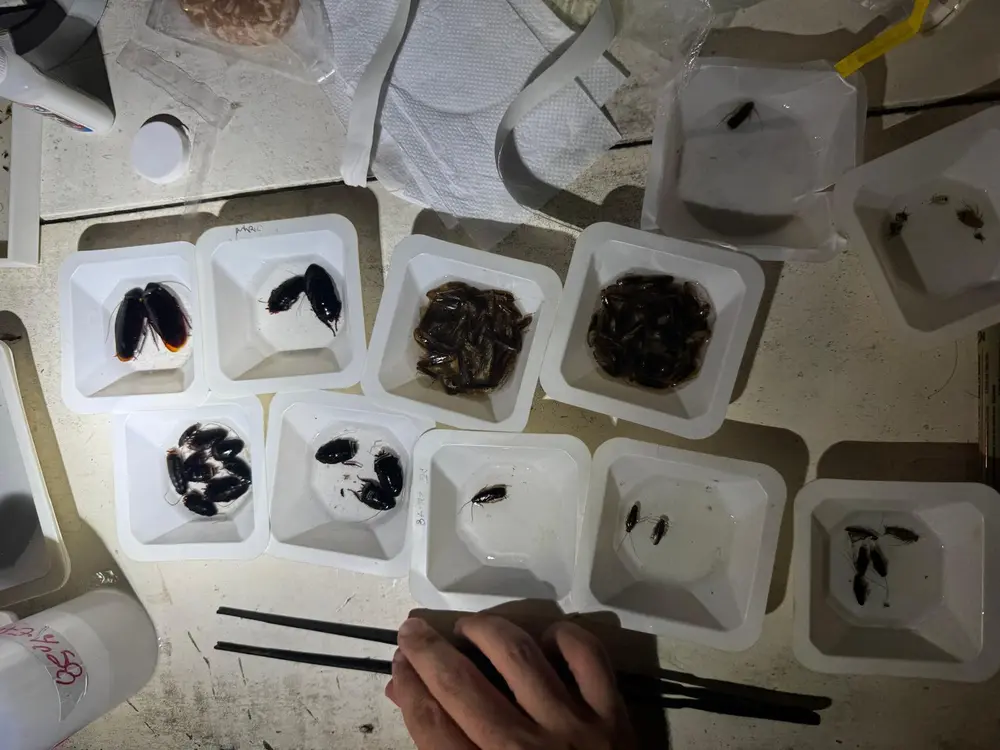
Cockroaches are often associated with feelings of disgust or fear, but they contribute to ecosystems in different ways than you may think. These contributions are something that six University students spent this past summer documenting in the Amazon rainforest.
These students studied both cockroaches and dragonflies to document which species are present in the area, identify and describe new species and map their evolutionary history.
Brazil is home to the largest portion of the Amazon rainforest, and Peru has the second-largest region, containing a vast diversity of ecosystems. The Amazon has millions of species, with many still uncataloged — something this research set out to change.
The team included Wardah Noor Syeda and Emmy Fiorella Medina-Espinoza, both graduate students studying ecology, evolution, & conservation biology.
Dominic Evangelista, professor in LAS and the principal investigator of Roach Brain Lab, oversaw the trip. In an email to The Daily Illini, Evangelista wrote that he received full funding for the expedition’s participants through a grant from the United States National Science Foundation.
For Medina-Espinoza, this trip was about more than just collection; she said it was about expanding knowledge of ecosystems that sustain the Amazon.
One significant contributor to these ecosystems is cockroaches. They play a critical role, according to Medina-Espinoza, and if they were to go extinct, it would likely disrupt the populations that feed on them and the plants they pollinate.
“If we want to keep the Amazon as it is, we need to care about what makes the Amazon the Amazon,” Medina-Espinoza said.
The Amazon has been widely undisturbed by humans, something that played an important role in the team’s choice, according to Syeda. Research on cockroaches and dragonflies is scarcely documented across South America, said Syeda.
“Any ecological place where you have all of these organisms living together is like a closed-off zoo where humans have no role in it,” Syeda said. “Real-time observation is something that is very key to the discovery and description of insects and entomology.”
The result of this research was significant: The team collected 2,505 cockroaches and 72 dragonflies, according to Evangelista.
Cockroaches’ and dragonflies’ diversity is crucial for researchers to understand how other organisms function, Syeda said.
Dragonflies eat other flying insects, which helps keep insect populations in check, and their presence can even signify clean water and a healthy freshwater ecosystem. Cockroaches are beneficial to ecosystems as food sources for ants, lizards, mice, and some species can even be pollinators.
According to Syeda, the collection process varied for each insect. She said the students used a flying net to catch dragonflies, but for cockroaches, they relied on aspirators — devices that pulled the insects into a vial, then used ethanol to kill them. Syeda said the process was “super fun,” despite preconceived notions that cockroaches are “gross.”
Despite wielding a net for capturing dragonflies, they proved far more challenging to hold, according to Syeda.
“They’re faster than your net; they’re even faster than your eyesight,” Syeda said about dragonflies. “You have to sit for hours to be able to catch enough.”
Once caught, Syeda said the team would carefully remove the dragonflies from the net by their wings and place them in paper envelopes to dry. Then, the team cataloged the insects by locality and species, which is important for post-collection research, according to Syeda.
One of the main takeaways from this trip, Syeda said, was the overall cultural experience, as the students learned to respect other customs while conducting their research.
“The people were so welcoming and sweet, and I barely could speak any Spanish,” Syeda said. “We would coincide over having tea or just laughing over music that the other person may not understand.”