
Scientists at the University of Illinois Urbana-Champaign have helped uncover how fish skin protects fish from sharp, fast attacks in the wild, and the research highlights how curiosity, creativity, and mentorship can come together to drive discovery. The study was co-authored by Phil Anderson, an Associate Professor of Evolution, Ecology, and Behavior, and his former undergraduate student Bishal Baskota, who first asked the questions that led to the research and helped guide it from idea to publication.
The research, published in the Journal of Experimental Biology, explores how fish skin and scales respond when struck by sharp objects at extremely high speeds. In nature, fish face predators like cone snails, which use needle-like radular teeth to strike in the blink of an eye. These attacks happen so quickly that they are difficult to study, and until now, most lab tests did not fully capture how fish skin behaves in real life.
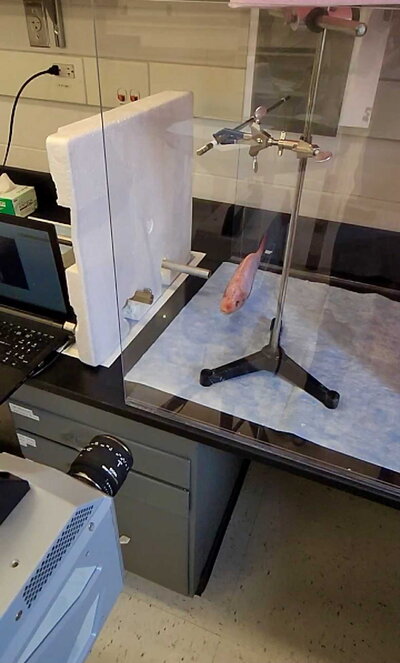
As an undergraduate student, Baskota was curious about what happens during these fast attacks. Instead of following traditional testing methods, he pushed to explore new ways of studying fish skin that better matched natural conditions. Working with his mentor Dr. Anderson and Anderson’s former Postdoctoral Research Associate Dr. Bingyang Zhang (now at Texas State), he helped design experiments that allowed fish to move freely while being struck by sharp tools moving at realistic speeds. This creative approach made it possible to see how fish skin truly responds under pressure.
The team tested samples from fish like salmon and tilapia, comparing samples with both skin and scales to samples without them. They found that fish skin offers strong protection, even though it is thin and flexible. Samples with skin and scales resisted punctures better and showed less damage. The researchers also discovered that movement matters. When the fish was not held in place, some of the force from the strike went into moving the fish instead of piercing its tissue, reducing injury. This suggests that a fish’s ability to move during an attack plays an important role in its survival.
Dr. Anderson, who served as the study’s principal investigator, emphasized the value of working together across experience levels to answer complex questions. By guiding the project while encouraging Baskota to test bold ideas, he helped create a research environment where learning, leadership, and collaboration went hand in hand. The study reflects how shared problem-solving can lead to stronger science and more meaningful results.
Beyond helping scientists better understand how fish survive in the wild, the findings may also benefit people. Learning how fish skin combines flexibility and toughness could inspire new protective materials, such as cut-resistant clothing, lightweight armor, or materials used in robotics. The study shows how nature’s designs can offer smart solutions to modern challenges.
The project also demonstrates the impact undergraduate students can have when they are encouraged to ask questions and explore new ideas. Baskota’s work shows how student curiosity, paired with supportive mentorship, can lead to real scientific advances.